
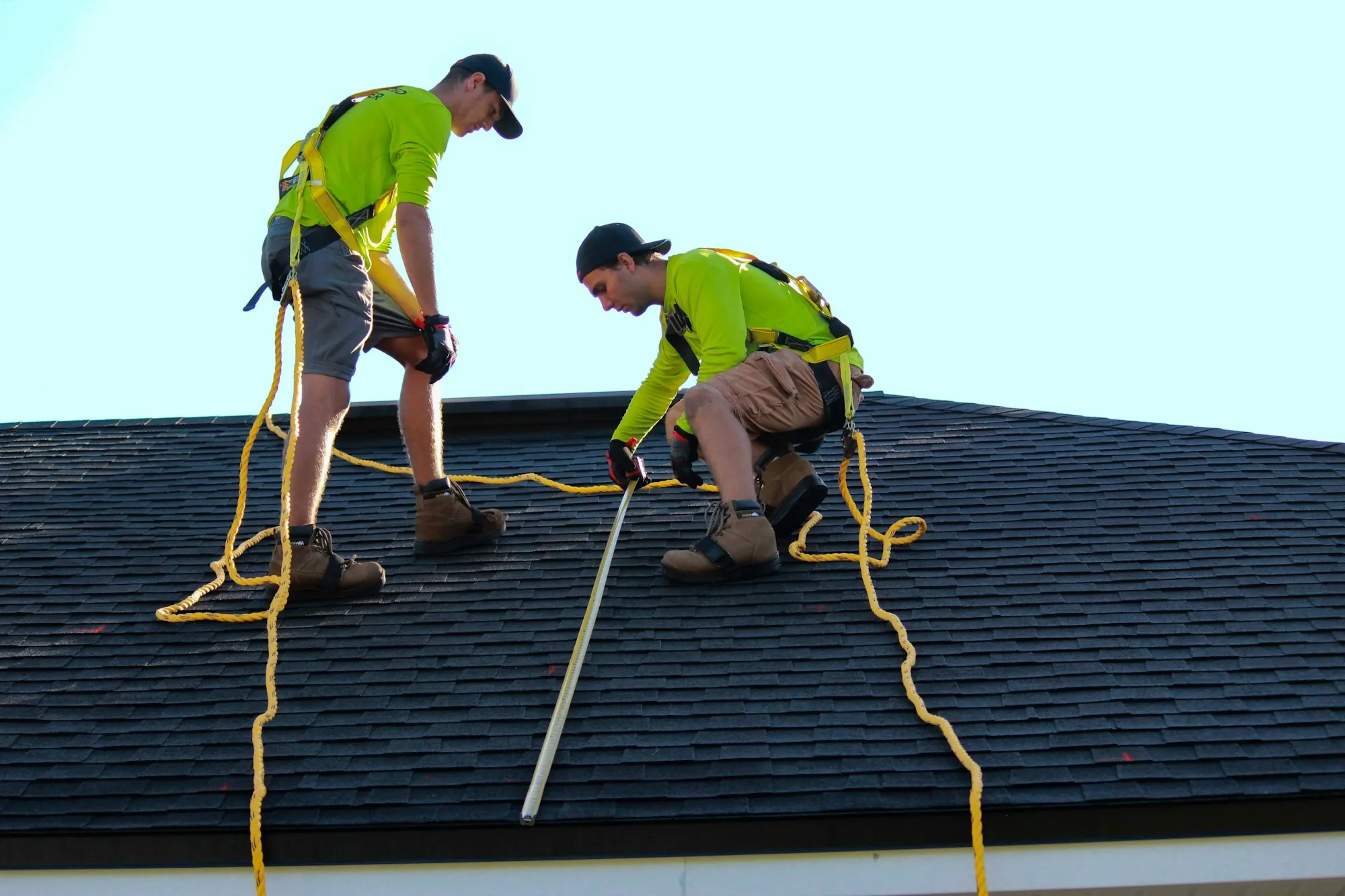
On a Brookhaven street lined with oaks and parked cars, roof replacement day starts with a truck, a trailer or dumpster, and a pile of tarps. What follows is a sequence that rarely changes from house to house: protect the property, strip the old roof, repair the deck, dry it in with underlayment and metal edges, install the new shingles and vents, then clean up. Knowing each roof replacement step ahead of time makes the noise and the traffic in the yard a lot easier to live with for a day.
Key takeaways
- A full roof replacement follows a fixed order: protect, tear off, repair the deck, dry in, shingle, ventilate, clean up and walk the job.
- The old roof comes off down to the wooden deck so rotten boards can be found and replaced before anything new goes on.
- Drip edge, underlayment and leak barrier go down before a single shingle is nailed.
- Georgia’s state minimum codes include the International Residential Code with Georgia amendments, which sets the baseline for how a new roof is installed.
- Cleanup includes a magnetic sweep for nails across the lawn, beds and driveway.
- Homeowners can stay home, but cars, patio furniture and wall hangings near the roofline should be moved first.
Step 1: The crew protects the house and yard
Protection comes first because tear-off sends shingles, nails and dust off every edge of the roof. Crews lay tarps over shrubs, flower beds and the foundation line, lean plywood or tarps against windows and doors near the drop zone, and park the dumpster or trailer where debris can go straight in. On many Brookhaven lots the driveway is the only flat spot for it, which is why your cars need to be on the street or a neighbor’s pad before the crew arrives.
This is also the moment to point out anything the crew should know about: an irrigation head near the house, a gas meter, a dog that uses the backyard, or a soft area of lawn where a heavy truck should not roll.
Step 2: The old roof comes off down to the deck
Tear-off means removing every existing layer of shingles, felt and old flashing until bare wood is showing. It is the loudest part of the day, and the part that moves the fastest. Workers start at the ridge and work down, scraping shingles into the dumpster or onto tarps, then pull leftover nails so the deck is flat.
A full tear-off matters because it is the only way to see the deck itself. Shingles laid over an old roof hide soft wood, old leaks and earlier patch jobs, and they make it harder for the new roof to lie flat. If your house has two layers, expect a longer tear-off and a fuller dumpster.
Step 3: Bad decking is cut out and replaced
Deck repair is the step nobody can price exactly until the old roof is off. Once the wood is exposed, the crew walks the roof looking for soft, delaminated or water-stained sheathing, and any section that flexes or crumbles gets cut out and replaced with new panels. A good quote lists a per-sheet price for this ahead of time, so the number on the final invoice is not a surprise.
In Brookhaven, replacing sheathing is the kind of structural work the City of Brookhaven’s permit FAQ names as requiring a permit, so ask your roofer how a permit is handled on your job before work starts.
Step 4: Drip edge, underlayment and leak barrier go down
Drying in is the step that makes the house watertight again, even before shingles go on. Metal drip edge goes along the eaves and rakes, self-sealing leak barrier membrane goes into the valleys and around pipes and other spots where water collects, and synthetic underlayment covers the rest of the deck. The Asphalt Roofing Manufacturers Association explains that, as a general guideline, drip edge goes under the underlayment at the eaves and over it at the rakes, and that it is strongly recommended on all shingled roofs.
Once this layer is on, a passing summer thunderstorm is far less of a worry. Crews in metro Atlanta watch the radar closely and usually open only as much roof as they can dry in before they leave.
Step 5: Shingles go on from the eaves up
Shingle installation starts at the bottom edge and works toward the ridge in overlapping courses. A starter strip runs along the eaves and rakes first so the first course has a sealed edge. Then each row of shingles is nailed in the pattern and nail count the manufacturer calls for, with step flashing woven in where the roof meets a wall.
The baseline for all of this is set by code. The Georgia Department of Community Affairs lists the International Residential Code with Georgia amendments among the state’s current mandatory minimum codes, and the shingle maker’s printed instructions add their own requirements for nailing, exposure and slope on top of it.
Step 6: Vents, pipe boots and ridge cap are finished
Ventilation and roof penetrations are finished near the end, because they tie into the top courses of shingles. Old pipe boots are replaced rather than reused, roof vents or a ridge vent go in, and ridge cap shingles are nailed along the peak to close it off. According to the Asphalt Roofing Manufacturers Association’s ventilation guidance, improper ventilation can lead to premature deterioration of shingles and the roof deck, and a balanced system with intake low and exhaust high works best.
This is a good point to ask the crew what they found in the attic and whether the vent setup changed from the old roof.
Step 7: Cleanup and the final walk
Cleanup is the last scheduled step, and it should leave the yard looking like the crew was never there. Tarps come off the beds, loose debris is raked up, gutters are cleared of granules and stray nails, and a rolling magnet is run across the lawn, driveway and walkways. The dumpster or trailer leaves with the old roof.
Before the crew leaves, walk the property with the lead. Look at the drip edge line from the ground, check that gutters are still firmly attached, and ask for photos of the deck repairs and any areas you cannot see from below.
What Can Stretch Install Day Into Two
Most of the variation in a roof replacement schedule comes from four things: weather, the deck, the roof’s shape and the number of old layers. A clear forecast lets a crew tear off and dry in steadily, while a line of summer storms can force them to stop, seal what is open and come back. Crews would rather pause than leave bare wood exposed to a downpour.
The deck is the second variable. A roof with only a few soft boards barely slows down, but widespread rot near the eaves or around an old leak means more cutting, more new panels and more time before underlayment can go down.
Shape matters too. A simple two-slope roof on a ranch house goes faster than a steep roof with dormers, several valleys and walls that each need step flashing. Steep pitches also call for extra safety setup, roof jacks and boards, which takes time on both ends of the job.
Finally, two layers of old shingles roughly double the tear-off and the debris. None of these are reasons for worry. They are just the questions worth asking when you get a quote, so the timeline you hear matches your house.
How to Get Your House Ready the Day Before
The single best thing you can do is clear the drop zone. Move cars off the driveway, pull patio furniture, grills and planters away from the walls, and take pictures and mirrors off walls on the top floor, since hammering can shake them loose. Cover belongings in the attic with old sheets to catch dust. Let neighbors know a dumpster and some noise are coming, and keep pets inside or away for the day.
If you are still at the stage of deciding whether your roof needs replacing at all, a roof inspection is the place to start. When the answer is yes, Roofing Pros Brookhaven can walk you through how a roof replacement on your house would run, and the home page has more on what we do.